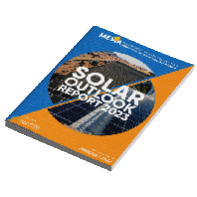
MESIA Solar Outlook Report 2026 Comprehensive Analytical Summary

Grid Integration, Digitalization, and the Structural Evolution of Solar Across MENA

RX

Full report download:
Full Solar Outlook Report 2026 PDF

Solar Outlook Report 2026 — Comprehensive Analytical SummaryIntroductory Overview

The Solar Outlook Report 2026, released in January 2026, presents a detailed assessment of the solar energy sector across the Middle East, North Africa, and selected MENASA markets. Produced by the Middle East Solar Industry Association (MESIA), the report examines how the region’s solar industry is transitioning from rapid capacity expansion toward a more structurally complex phase defined by grid integration, digitalization, automation, and system resilience.

The report situates 2026 as a turning point for both global and regional solar markets. While cumulative global solar installations exceeded 500 gigawatts AC by the end of 2025, the report notes that annual additions may slow for the first time in two decades due to structural policy changes, particularly in China. Against this backdrop, the Middle East is characterized as accelerating from ambition toward execution, supported by enforceable policy frameworks, large-scale procurement programs, and the convergence of solar energy with data infrastructure and artificial intelligence.

Purpose, Publishing Organization, and Scope

The purpose of the report is to provide a forward-looking yet evidence-based outlook on the evolution of solar power systems in the MENA region, with emphasis on infrastructure readiness, technology performance in desert conditions, digital systems, market structures, and regional differentiation.

MESIA serves as the publishing organization and industry reference source. The report does not position MESIA as a regulatory authority or governing body, but rather as a convening platform aggregating technical, market, and policy intelligence from across the solar value chain.

Geographically, the report covers the Gulf Cooperation Council, North Africa, and selected markets within the broader MENASA region, including detailed country sections on Algeria, Bahrain, Egypt, India, Iran, Iraq, Kuwait, Lebanon, Morocco, Saudi Arabia, Syria, Tunisia, and the United Arab Emirates. The timeframe primarily reflects developments through 2025, with forward-looking implications extending toward 2030 and beyond.

Power Systems and Grid EvolutionStrengthening Grid Infrastructure for a Renewable-Dominant MENA

The report identifies grid infrastructure as the most critical constraint and enabler of renewable energy expansion in the region. Solar and wind capacity are being deployed at unprecedented speed, placing strain on transmission networks originally designed for centralized, gas-fired generation.

In 2025 alone, more than USD 19 billion in solar contracts were awarded across the GCC. Over the past decade, nearly USD 62 billion in solar photovoltaic contracts have been awarded, with Saudi Arabia accounting for approximately 60 percent of this total. These investments have fundamentally altered power flow patterns, requiring utilities to accommodate greater variability, longer-distance transmission, and higher operational complexity.

Grid reinforcement efforts across the region include expansion of 380 kV and 400 kV transmission corridors, construction of gas-insulated substations, installation of shunt reactors and capacitor banks, and deployment of advanced control and protection systems to maintain voltage and frequency stability.

Saudi Arabia is highlighted as the most active market. By late 2025, the country had signed 43.2 GW of renewable capacity, with 12.3 GW already connected. Saudi Electricity Company has embarked on a USD 58.7 billion investment program for 2025–2030, including USD 36 billion allocated to transmission alone.

A recurring challenge identified is timing. Solar plants can move from tender to commissioning in two to three years, while major transmission projects often require five to seven years. This mismatch is described as one of the most significant operational risks facing system operators.

Agri-PV Systems for the Desert

The report presents agrivoltaics as a dual-use solution addressing energy generation, water scarcity, and food resilience. A pilot project in Fujairah, United Arab Emirates, serves as a central case study.

Field data collected in mid-2025 demonstrate that agrivoltaic systems can maintain reliable power output while improving crop survival, soil quality, and water efficiency. Shaded areas exhibited lower salinity, higher moisture retention, and improved organic matter, while native plants showed reduced heat stress and longer growing periods.

The report emphasizes scalability, noting that the system relied on standard ground-mounted structures rather than specialized agrivoltaic frames.

Energy Storage in MENA: The Backbone of Grid Stability

Energy storage is identified as essential for enabling higher renewable penetration. Solar and wind accounted for nearly 6 percent of MENA’s estimated 2,000 TWh of power generation in 2025 and are projected to reach approximately 20 percent by 2030.

As of 2025, there were 17 operational utility-scale battery energy storage projects totaling more than 2.9 GW, with expected capacity exceeding 29 GW by 2030. Saudi Arabia and the UAE dominate deployments, including some of the world’s largest solar-plus-storage projects.

Energy storage is framed as a structural component of future power systems, supporting peak demand, reducing curtailment, and lowering dependence on fossil-fuel backup generation.

Technology and InnovationPV Technologies Built for Desert Performance and Longevity

The report stresses that desert environments fundamentally challenge conventional assumptions about photovoltaic performance. Field testing and accelerated laboratory protocols show significant divergence between theoretical efficiency and real-world outcomes.

TOPCon technology demonstrated superior performance ratios and thermal stability compared with heterojunction and back-contact technologies under combined heat and humidity stress. Accelerated “Desert Code” testing highlighted the importance of localized validation.

Smarter Solar Farm Design

Abundant land availability introduces design complexity. The report emphasizes techno-economic modeling to balance ground coverage ratio, tilt, spacing, and DC/AC sizing to minimize levelized cost of energy over multi-decade lifetimes.

Market Intelligence on Solar PV Production

The Middle East is transitioning toward domestic manufacturing of photovoltaic components. Projects across Saudi Arabia, the UAE, Egypt, and Oman are driven by localization policies, trade dynamics, and industrial diversification goals.

Digitalization and Smart Systems

The report outlines convergence between solar energy, data centers, and artificial intelligence. More than USD 4.1 billion in GCC data center projects were awarded between 2017 and late 2024, with capacity expected to more than triple.

Automation, robotics, and AI-driven analytics are transforming construction, operation, and maintenance. These systems improve safety, reduce water use, and enable predictive maintenance in remote desert environments.

Policy, Finance, and Market Development

Utility-scale solar procurement remains dominant, supported by competitive auctions and long-term power purchase agreements. Procurement criteria increasingly incorporate storage, dispatchability, and grid services.

Localization policies link energy transition objectives with industrial development and economic diversification.

Regional Focus and Country Highlights

Country sections provide proportionate assessments of market maturity and deployment conditions. Saudi Arabia and the UAE emerge as anchor markets, while Egypt and Morocco are highlighted for early adoption and export-oriented strategies.

Closing Synthesis

The report concludes that the MENA solar sector is entering a phase defined by system integration, intelligence, and resilience rather than capacity growth alone. Grid readiness, storage deployment, digitalization, and technology suitability under extreme conditions are the primary determinants of success.

Collectively, the report presents a region positioning itself at the intersection of clean energy and digital transformation, with near- to mid-term progress shaped by disciplined execution and infrastructure coordination.