Global

This study explored mental health understanding and experiences within the Bangladeshi Deaf community, aiming to co-develop culturally and linguistically appropriate digital mental health tools.

By decoding environmental signals preserved in glaciers, this study reconstructs past climate variability. These long-term insights provide a powerful baseline to understand how today’s rapid warming deviates from natural patterns—and why urgent action is needed.

By mapping urban heat patterns, this study highlights how cities intensify climate impacts—and how smarter urban design can reduce heat stress. It showcases practical pathways to make cities more livable and climate-resilient.
This article presents a qualitative systematic review on the experiences of students with physical disabilities in inclusive education settings.
Elsevier, iScience, Volume 28, 21 November 2025
This perspective explores the idea of the “Earth Grid,” which proposes an intercontinental electric grid facilitated by three technological advancements: enhanced information and communication technology (ICT) applications in the electric grid, development of inter-country grids for power-sharing, and the application of artificial intelligence (AI) for efficient operation and maintenance.
The chemical industry must undergo a dual transformation: electrifying energy use and defossilizing carbon feedstocks. This paper, developed by ENGIEs Scientific Council, examines how energy and chemistry can converge to enable this shift.
Elsevier,

International Journal of Food Microbiology, Volume 442, 2 November 2025

This research underscores the potential of aquaponic systems to contribute to sustainable urban food production while emphasizing the importance of stringent water quality and hygiene practices to ensure food safety in global food systems.
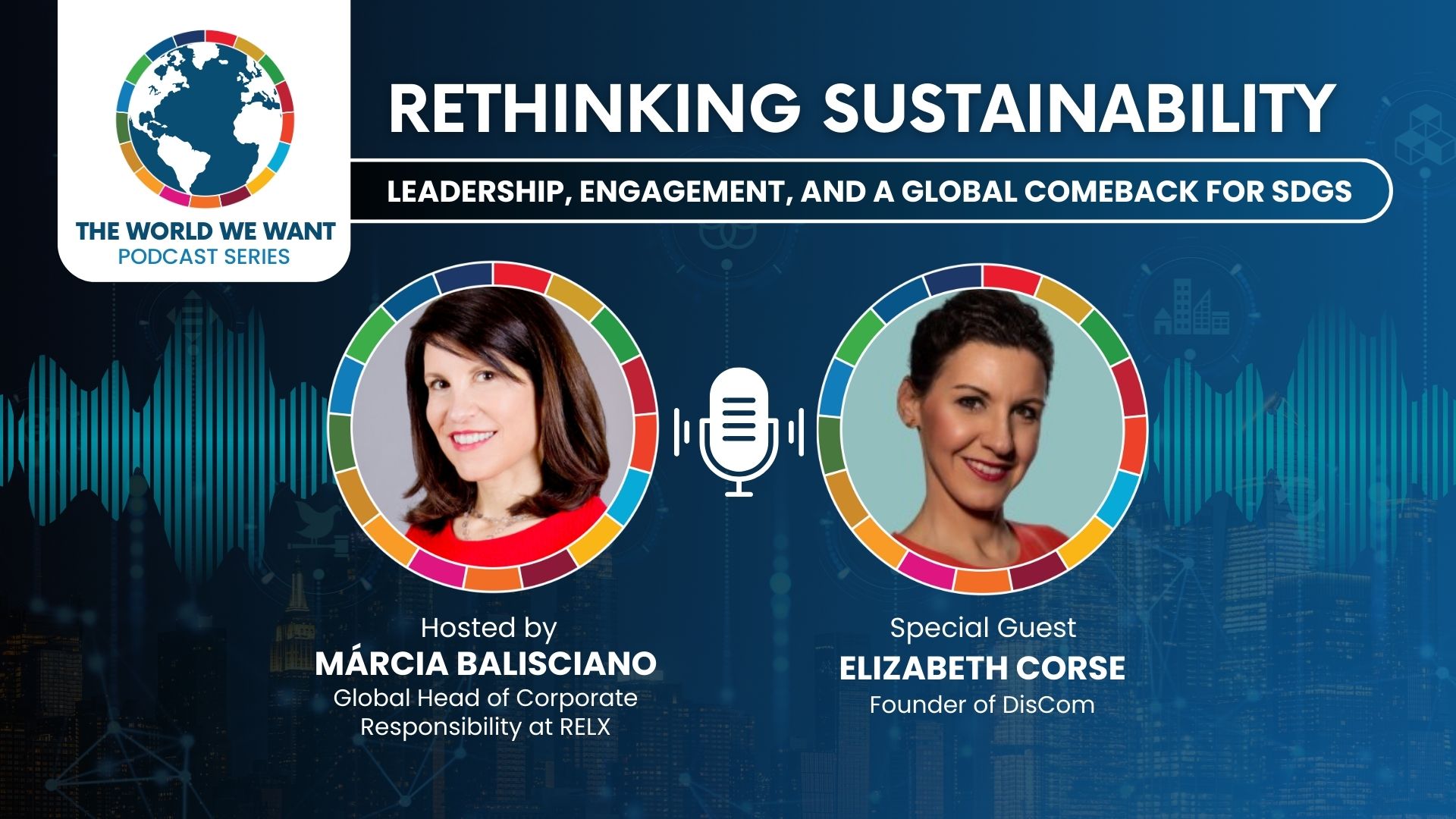
Podcast host and guest image against a blue background
In this episode of the "World We Want" podcast, Márcia Balisciano interviews Elizabeth Corse, Founder of DisCom. They discuss the need to move beyond “business as usual” and how empowering both citizens and company leaders is essential for real sustainability progress. They also explore how to identify organizations that genuinely embed sustainability and encourages renewed commitment to the UN Sustainable Development Goals (SDGs) as an opportunity for a global “comeback.”

COP30 is the 30th United Nations Conference of the Parties (COP), an annual global meeting where world leaders, scientists, non-governmental organizations, and civil society leaders gather to discuss actions to tackle climate change. It is considered one of the world's key events on the subject. COP30 is a historic opportunity for Brasil to reaffirm its leadership in climate change negotiations and global sustainability.

Elsevier, Sustainable Production and Consumption, Volume 60, November 2025
This study analyzes decarbonization efforts of 1,095 European firms, identifying six key strategic pathways—ranging from risk diagnosis to supply chain redesign—and uses a systems dynamics approach to reveal how these interconnected strategies influence climate risk performance. The findings offer valuable tools for managers and policymakers to coordinate supply chain actions more effectively, fostering continuous innovation and improved sustainability outcomes.

Pages