This report synthesizes discussions from the 2026 ADSW Advisory Committee on Green Hydrogen and Future Fuels. It examines the emergence of global hydrogen trade, supply side technological and industrial challenges, demand creation mechanisms, infrastructure and regulatory readiness, and financial models required to scale green hydrogen toward commercial maturity.

This report distills insights from the 2026 ADSW Advisory Committee on Climate and Governance. It examines structural reform of global climate governance, the catalytic role of private and blended finance, operationalization of Article 6 carbon markets, localization and inclusivity in climate decision making, and the governance of emerging climate technologies.

This report synthesizes insights from the 2026 ADSW Advisory Committee on Smart Cities and Mobility. It examines the role of AI in urban planning, the importance of human centric and nature integrated development, evolving mobility systems including EVTOL technologies, the balance between sustainability and affordability, and the long-term transformation of urban infrastructure.

This report synthesizes insights from the 2026 ADSW Advisory Committee on Nature and Biodiversity. It examines the need for standardized reporting frameworks, deeper integration between climate and biodiversity agendas, mobilization of private finance, scaling of nature based solutions, and cautious development of biodiversity markets.
This report synthesizes insights from the 2026 ADSW Advisory Committee on Climate Finance, examining the resilience of climate finance amid geopolitical uncertainty. It analyzes private capital flows, transition finance in the GCC, regulatory frameworks, and the evolving role of carbon markets in mobilizing sustainable investment.


This report presents a structured analysis of insights from an ADSW Advisory Committee meeting held in 2026, examining the technological, economic, and policy conditions shaping the global clean energy transition. It addresses grid optimization, emerging energy technologies, trade and supply risks, the evolving role of artificial intelligence, and the re-emergence of carbon markets as a potential financing mechanism.
This report synthesizes the outcomes of a high level UK–UAE clean energy roundtable convened in June 2026. It examines barriers to scaling clean energy, the role of government signalling and co-investment, priority technology areas for collaboration, and a set of strategic action recommendations aimed at accelerating the energy transition through deeper bilateral cooperation.
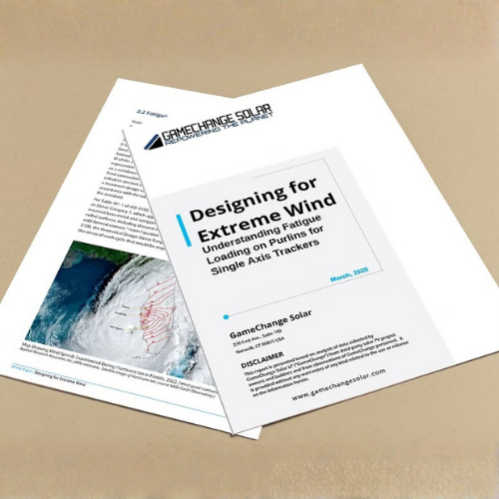
Short summary: This report explains how hurricanes and other long duration extreme wind events can generate repeated cyclic pressures on single axis tracker systems that accumulate as fatigue loading over time. It finds that commonly used standards and analytical approaches may not represent real hurricane cycle counts, pressure amplitudes, or the full module purlin assembly behavior.

Short summary: This report examines how the global energy transition entering 2026 is being reshaped by artificial intelligence, decentralised infrastructure, and resource resilience. It outlines how intelligence-driven systems, water security innovation, and cost-focused clean technologies are redefining energy generation, distribution, and industrial transformation.