How Sex and Gender Impact Clinical Practice: An Evidence-Based Guide to Patient Care (Second Edition), 2026, pp 11-23
This chapter aligns with SDG 3 – Good Health and Well‑Being and SDG 5 – Gender Equality by demonstrating how gender‑informed communication strategies can improve clinician‑patient interactions, leading to better healthcare outcomes and more equitable, culturally aware treatment experiences for women and other gendered patient groups.
Aquatic Waste Valorization: Innovative Approaches and Sustainable Strategies: 2026, Pages 29-52
This chapter aligns with UN Sustainable Development Goal 6 (Clean Water and Sanitation) and Goal 14 (Life Below Water) because it highlights how valorizing aquatic waste can reduce water pollution and protect aquatic ecosystems.
The transformative role of treated wastewater in North Africa: lessons learned and future directions
Mohamed Tawfik, Maha Al-Zu’bi, Youssef Brouziyne,
Chapter 2 - The transformative role of treated wastewater in North Africa: lessons learned and future directions,
Editor(s): Tafadzwanashe Mabhaudhi, Aidan Senzanje, Olufunke Cofie,
Agricultural Water Management in Africa,
Academic Press,
2026,
Pages 21-40,
ISBN 9780443215841,
https://doi.org/10.1016/B978-0-443-21584-1.00003-X.
The article directly supports SDG 6 (Clean Water and Sanitation) by demonstrating how treated wastewater can provide sustainable water solutions for agriculture in water-scarce North African countries. It also contributes to SDG 2 (Zero Hunger) by addressing food security challenges through innovative water management strategies that sustain agricultural production despite increasing water scarcity.
Karuppannan Iswarya, Ulaganathan Arisekar, Rajendran Shalini, Balasubramanian Sivaraman, Shanmugam Sundhar, Balamanikandan Vijayakumar, Antony J. Prabhu Philips,
Chapter 1 - Overview of aquatic food industry waste: challenges, opportunities, and sustainable valorization,
Editor(s): Piyush Kashyap, Tanmay Sarkar, Sajid Maqsood,
Aquatic Waste Valorization,
Academic Press,
2026,
Pages 3-27,
ISBN 9780443440274,
https://doi.org/10.1016/B978-0-443-44027-4.00013-5.
This chapter aligns with UN Sustainable Development Goal 6 (Clean Water and Sanitation) because it addresses the environmental impacts of aquatic food industry waste and explores sustainable strategies to reduce pollution and protect water resources.
Olufunke Cofie, Adesola Olaleye, Birhanu Zemadim, Tafadzwanashe Mabhaudhi,
Chapter 4 - Current status of agricultural water management in Africa: progress, challenges, and opportunities,
Editor(s): Tafadzwanashe Mabhaudhi, Aidan Senzanje, Olufunke Cofie,
Agricultural Water Management in Africa,
Academic Press,
2026,
Pages 69-85,
ISBN 9780443215841,
https://doi.org/10.1016/B978-0-443-21584-1.00014-4.
The article directly connects agricultural water management (AWM) to SDG 2 (Zero Hunger), emphasizing that effective water management is crucial for achieving food security and agricultural transformation in Africa. The policy agenda outlined aligns with both Agenda 2063 and SDG 2, highlighting how accelerated, context-specific AWM can unlock substantial gains in food security, climate resilience, and rural livelihoods. The connection is reinforced through specific targets mentioned in the introduction, where water management is explicitly integrated into five of the six CAADP strategic objectives, supporting goals like 45% increase in agricultural output and 50% reduction in losses. Additionally, the AU's Agenda 2063 aims to enhance water productivity by 60%, capture 10% of rainwater for productive use, and recycle 10% of wastewater, directly supporting sustainable development through improved resource management.
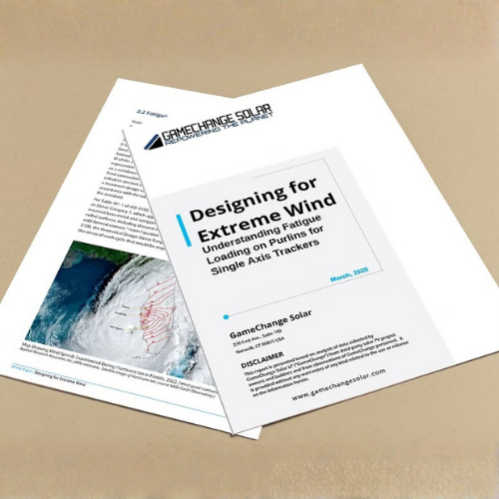
Short summary: This report explains how hurricanes and other long duration extreme wind events can generate repeated cyclic pressures on single axis tracker systems that accumulate as fatigue loading over time. It finds that commonly used standards and analytical approaches may not represent real hurricane cycle counts, pressure amplitudes, or the full module purlin assembly behavior.
Agricultural Water Management in Africa: Lessons Learned and Future Directions, 2026, pages 279-299
The research strongly aligns with SDG 5 (Gender Equality) through its focus on women's empowerment in agricultural decision-making and economic participation. The study also connects to SDG 1 (No Poverty) by demonstrating how agricultural innovations and water management have contributed to poverty reduction and economic opportunities for marginalized groups, particularly women. The circular economy model described, where women engage in rice production while men focus on vegetables, creates sustainable livelihoods that support both gender equality and poverty alleviation goals. Finally, the article strongly connects to SDG 6 (Clean Water and Sanitation) through its focus on water management innovations and infrastructure development.